




alttext


“Neutrality helps the oppressor, never the victim. Silence encourages the tormentor.” (Elie Wiesel, Nobel Peace Prize laureate)

Universal human rights are the cornerstone of international law, yet in a multipolar world their actual validity is increasingly called into question. Major powers use the rhetoric of human rights to advance their own interests and justify geopolitical narratives. The core issue is whether human rights will remain indivisible and universal, or whether they will be reduced to instruments of political maneuvering in today’s geopolitical, digital, and often representation-poor global landscape.

Since their development in the mid-20th century, human rights have enjoyed broad recognition and are often regarded as universal and shared values. Yet in today’s global conditions, a pressing question arises: do these values still retain their universality, or have their use and interpretation become instruments of influence for major powers and digital platforms?
The discussions focus on testing the universality of human rights, freedom of expression in the digital age, and the erosion of value-based solidarity amid war and propaganda.
By invitation
info@eihr.ee
HUMAN RIGHTS
IN A MULTIPOLAR
WORLD
REALITY
OR ILLUSION?


The discussions focus on testing the universality of human rights, freedom of expression in the digital age, and the erosion of value-based solidarity amid war and propaganda.

One of the central themes of the day is the deported children of Ukraine. Why does the so-called “international community,” which so often speaks of values, remain hesitant in its actions when tens of thousands of Ukrainian children have been violently taken from their homes and their fate remains unknown? And the question we ultimately must confront is both simple and deeply uncomfortable: do “universal values” apply equally to all children, or only to those whose story happens to be visible?


“Neutrality helps the oppressor, never the victim. Silence encourages the tormentor.” (Elie Wiesel, Nobel Peace Prize laureate)

Universal human rights are the cornerstone of international law, yet in a multipolar world their actual validity is increasingly called into question. Major powers use the rhetoric of human rights to advance their own interests and justify geopolitical narratives. The core issue is whether human rights will remain indivisible and universal, or whether they will be reduced to instruments of political maneuvering in today’s geopolitical, digital, and often representation-poor global landscape.

Since their development in the mid-20th century, human rights have enjoyed broad recognition and are often regarded as universal and shared values. Yet in today’s global conditions, a pressing question arises: do these values still retain their universality, or have their use and interpretation become instruments of influence for major powers and digital platforms?
The discussions focus on testing the universality of human rights, freedom of expression in the digital age, and the erosion of value-based solidarity amid war and propaganda.
REALITY
OR ILLUSION?


The discussions focus on testing the universality of human rights, freedom of expression in the digital age, and the erosion of value-based solidarity amid war and propaganda.

One of the central themes of the day is the deported children of Ukraine. Why does the so-called “international community,” which so often speaks of values, remain hesitant in its actions when tens of thousands of Ukrainian children have been violently taken from their homes and their fate remains unknown? And the question we ultimately must confront is both simple and deeply uncomfortable: do “universal values” apply equally to all children, or only to those whose story happens to be visible?

Program


“Neutrality helps the oppressor, never the victim. Silence encourages the tormentor.” (Elie Wiesel, Nobel Peace Prize laureate)

Universal human rights are the cornerstone of international law, yet in a multipolar world their actual validity is increasingly called into question. Major powers use the rhetoric of human rights to advance their own interests and justify geopolitical narratives. The core issue is whether human rights will remain indivisible and universal, or whether they will be reduced to instruments of political maneuvering in today’s geopolitical, digital, and often representation-poor global landscape.

Since their development in the mid-20th century, human rights have enjoyed broad recognition and are often regarded as universal and shared values. Yet in today’s global conditions, a pressing question arises: do these values still retain their universality, or have their use and interpretation become instruments of influence for major powers and digital platforms?
The discussions focus on testing the universality of human rights, freedom of expression in the digital age, and the erosion of value-based solidarity amid war and propaganda.
1

“Lost but Not Forgotten: Ukraine’s Children
and the Hope of Return”
“Is our compassion determined by geography or by media coverage? Ukrainian children are still waiting for attention just as the children in Gaza are…”

One of the central themes of the day is the children deported from Ukraine. Why does the international community, which so often speaks of values, remain so hesitant in its actions when tens of thousands of Ukrainian children have been violently taken from their homes and their fate remains unknown? The question we ultimately must confront is simple, yet deeply uncomfortable: do universal values apply equally to all children — or only to those whose stories happen to be visible?

According to Ukraine’s official Children of War registry, a total of 19,546 children have been taken to Russia or to territories under Russian control. Official reports indicate that approximately 1,625 children have been returned, but the whereabouts of more than 17,900 children remain unknown or their repatriation is still ongoing.
Repatriation is coordinated through Ukraine’s national programme Bring Kids Back UA, in cooperation with the international coalition, UNICEF, the International Committee of the Red Cross (ICRC), and other partners; in some cases, Qatar has also provided assistance. The main objectives are identifying and reuniting children, increasing transparency and accountability, ending unlawful transfers, and accelerating their return.

If we accept that some children are a “geopolitical inevitability,” then we have already abandoned the very values by which we claim to measure the world.

2

Techno-feudal age: who owns the digital land?
Land = data. The manor = the platform. The tithe = your visibility
Who controls freedom of expression in an era where platforms and algorithms decide which truth becomes visible?

In a multipolar world, digital techno-feudalism must be analysed critically, especially in the context of human rights and freedom of expression. The language of human rights can be as easily manipulated as the algorithms that distribute it, and freedom of speech and human rights may not function as substantive principles, but rather as rhetorical instruments through which platforms and power centres justify control and influence. Appeals to the protection of freedom often serve as justification for censorship, restrictions, and the imposition of a single narrative to reinforce authority.

Digital techno-feudalism is driven by major platforms, data controllers and cyber-power centres that command data and infrastructure and thereby shape political, economic and cultural processes.

This manifests in disinformation, targeted influence operations and widespread surveillance. Effective resistance to this system cannot rely solely on technical solutions; it requires legal, economic and social frameworks that ensure transparency, accountability and societal resilience.

It is also significant that terms such as “democracy,” “freedom of expression” and “human rights” have, in the context of digital techno-feudalism, become strategic and communicative tools that serve less to legitimate rights than to enable the consolidation and exercise of power.

3

“Freedom and Responsibility in an Era of Resurgent Authoritarianism – The Road Toward Post-Putin Justice”


This discussion focuses on a fundamental question: Are human rights even possible in Russia, a country with a history and political culture dominated by hierarchical power structures and a tradition of impunity, rather than individual rights and accountability? Since 2022, the “language of freedom” in Russia has become a political tool used to justify war, repression, and the distortion of truth. Meanwhile, Russian journalism, civil society, and the diaspora face the ongoing challenge of preserving an ethical compass and the true meaning of free expression in a climate where independent media operates under the control of digital platforms and propaganda.The authoritarian system has created a state of “human rights fatigue,” where defending freedom and truth demands exceptional resilience.

Can we truly speak of universal human rights in a society that has constructed its own version of “Russian values”? Furthermore, is it possible for ethical continuity and the concept of freedom to survive without a functioning state, especially when exile may be the only path to maintaining independent thought and moral responsibility?

This discussion aims to explore whether post-Putin justice and freedom can be achieved in a society where truth has been transformed into an ideological resource, and whether the universality of human rights can remain relevant in a world that Russia seeks to redefine with its own so-called “universal values.”

4

Is there such a thing as multipolar human rights?
“In a multipolar world, the universality of human rights is increasingly called into question, turning them into political rhetoric dependent on the interests of major powers.”

International law does not recognize the concept of “multipolar human rights,” yet in practice it is increasingly used as political rhetoric through which major powers seek to interpret human rights in line with their own strategic interests. Although international conventions since the 1948 Universal Declaration of Human Rights affirm that rights are universal, indivisible and equally applicable, this principle is ever more frequently contested in a multipolar world.

Western “liberal universality” no longer holds a dominant or self-evident position: new and old power centres – China, Russia, India, Brazil, as well as Western states – emphasize their “cultural particularity” or “sovereign values,” undermining the real validity of universality. As a result, human rights often become slogans or instruments of geopolitical bargaining rather than values guaranteed equally for all, reflecting the broader tension between a universal normative framework and a multipolar political reality.

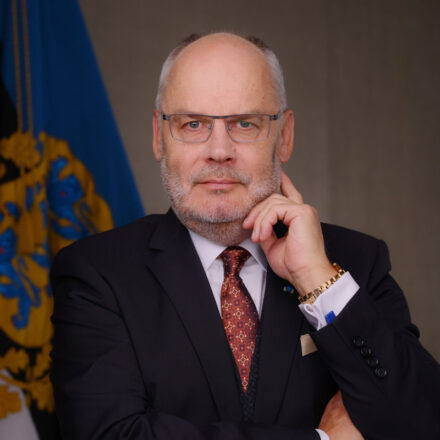
The Patron of the Annual Human Rights Conference is
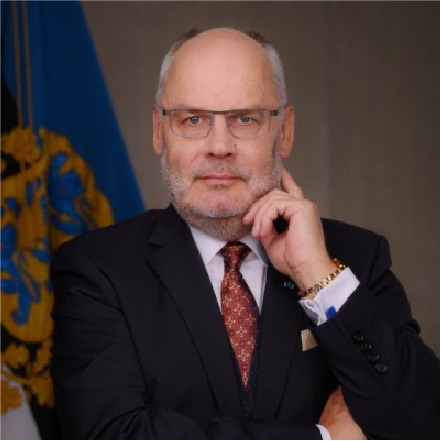
the President of the Republic of Estonia, Alar Karis

“The problem of human rights and security has not disappeared. It is often perceived that on one side of the scale lie human rights, and on the other, security. As the international situation becomes tenser, we may need to make concessions in the name of security—leading to greater restrictions on rights and freedoms.”